
The EU AMLR Arrives in July 2027
Are you ready for new Identity Verification and AML requirements?
The regulation reshapes KYC requirements across every EU market and beyond financial services.
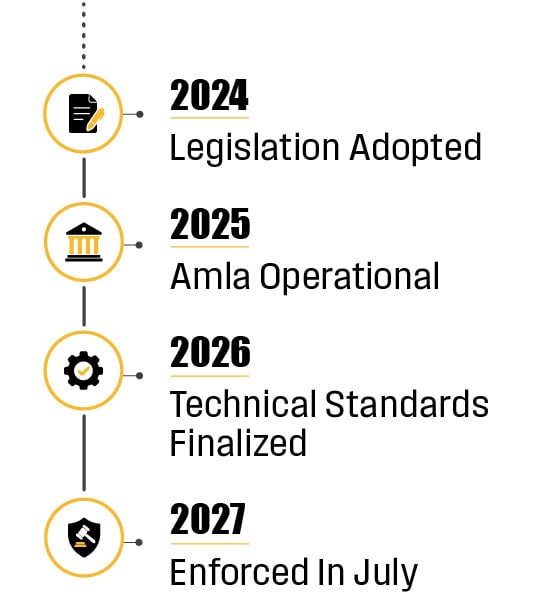
- One regulation, binding directly in every EU member state. Enforced from July 10, 2027.
- Fines for non-compliance: €10 million or 10% of turnover, whichever fine is higher.
- More organisations will be subject to AML requirements, including credit unions, crypto-asset and crowdfunding providers, high-value goods traders, football clubs and agents, and gambling operators.
- Identity verification now sits at the centre of compliance and becomes stricter: EUDI Wallet acceptance, eIDAS compliance and Qualified Digital Signatures are now mandatory.
Get Ahead of AMLR Before Enforcement Begins
Schedule a demo to see how Identity Continuity and TrustX help you meet the new requirements across every market you operate in.
The regulatory landscape for Anti-Money Laundering (AML) compliance is changing faster than most organizations have accounted for. The EU AML Regulation replaces five overlapping directives with one directly applicable rulebook. The list of obliged entities also expands well beyond banks to include crypto-asset service providers, real estate professionals and, eventually, professional football clubs, with many building AML infrastructure for the first time.
Identity verification requirements are becoming more prescriptive. The AMLR recognises eIDAS-compliant electronic identification at “substantial” or “high” assurance levels, relevant qualified trust services and other approved remote verification methods. Organisations will need consistent, auditable identity checks that work across markets and support stronger verification when risk changes. Beneficial ownership rules also tighten, including a threshold of 25% or more and a possible 15% threshold for specified higher-risk entities.
A new authority, AMLA, brings more consistent supervision and stronger enforcement. Serious compliance failures can lead to fines of up to 10% of annual turnover or €10 million, alongside the public disclosure of enforcement decisions. Waiting for the final technical standards could leave organisations implementing under deadline pressure. Those that act now can build the requirements into their identity infrastructure instead of retrofitting them later
Identity Continuity supports that shift by maintaining confidence in the customer’s identity beyond initial onboarding. TrustX provides the orchestration layer to manage verification, step-up checks and re-verification consistently across channels, identity methods and markets.
TrustX brings Identity Continuity to life. It's a low-code orchestration platform that unifies identity verification, document verification, and risk decisioning under a single compliance framework, giving a compliance manager or group-wide money laundering officer one coordinated view instead of a patchwork of tools across markets.
| Challenge | Response |
|---|---|
| Newly Obliged, No Infrastructure | Crypto providers, real estate, and other newly covered entities need CDD capability built fast. Deploy xProof for document verification and IdentityX for onboarding, without building from scratch |
| Legacy IDV Infrastructure | Older IDV systems can be difficult to adapt as assurance requirements and accepted identity methods evolve. xProof modernises document and biometric verification, while TrustX orchestrates verification and step-up checks across the customer journey. |
| Fragmented Compliance Across Markets | Different tools per jurisdiction create inconsistent assurance. TrustX orchestrates identity verification and decisioning under one platform, uniform across every market. |
| Group-Wide Governance Mandates | Parent companies must ensure subsidiary compliance and group-wide risk assessment. TrustX gives compliance managers a single, coordinated view across every subsidiary and channel. |
| Enforcement and Audit Exposure | Public enforcement and steep fines raise the cost of gaps. Identity Continuity maintains a verifiable record of assurance from enrollment through every transaction. |